
The B-complex a nutritionist actually loves — and why
Most people don't have an energy problem. They have a conversion problem.
A lot of people think they have an energy problem. They actually don't — they have a conversion problem.
It's the kind of insight you only get from someone who's spent years watching clients drag tubs of generic B-complex through their wellness routines without noticing a difference. The B vitamins were there. The cells just couldn't use them.
The fix isn't more milligrams. The fix is the form.
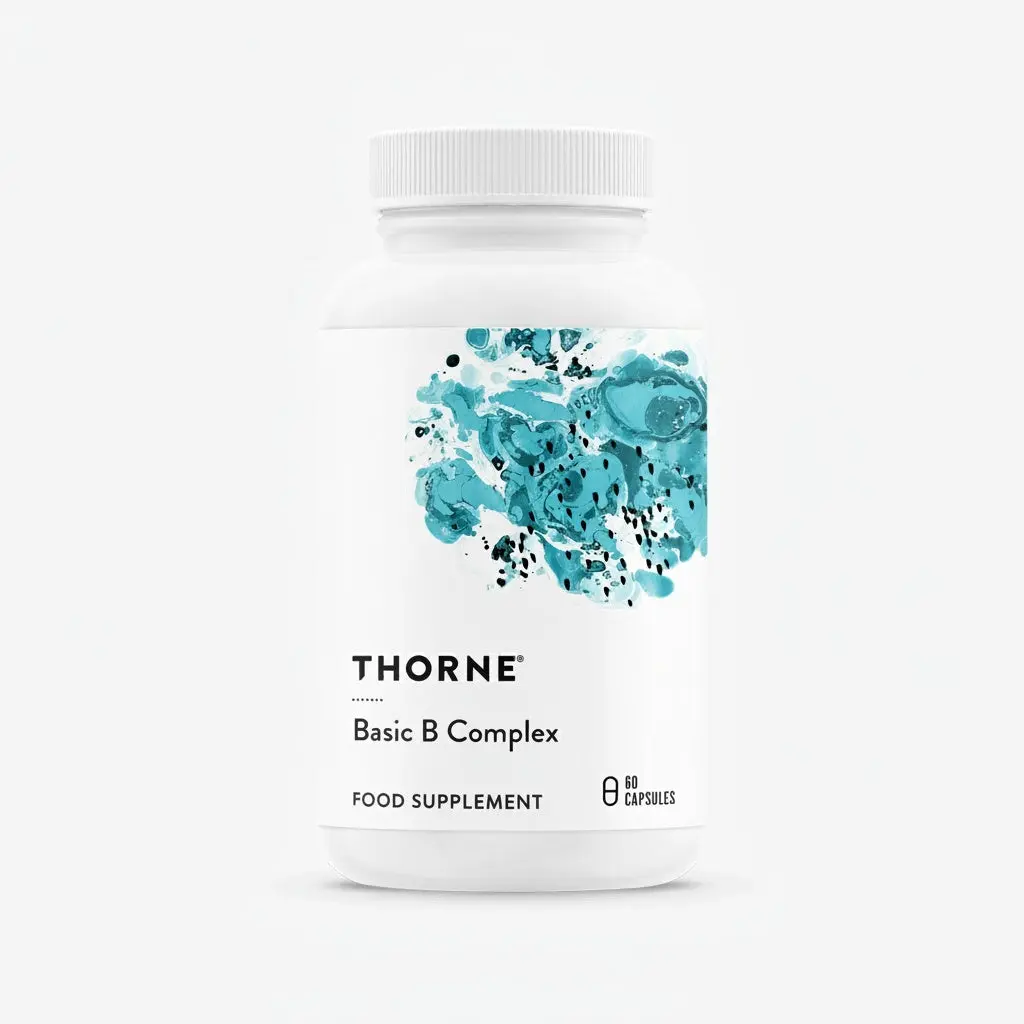
Thorne Basic B Complex
Active coenzyme forms of every B vitamin. One capsule a day. NSF-certified facility — the strictest US third-party standard for supplements. 60 capsules per bottle.
Get it on Healf →Three things that make this one different
Active forms across the board
Methylfolate, not folic acid. Methylcobalamin, not cyanocobalamin. P-5-P, not pyridoxine HCl. Less metabolic work — your cells get the vitamin already in the form they actually need.
Balanced, not megadosed
No heroic single-nutrient amounts. The right ratio across all eight B vitamins, in doses your body can actually use — no B6 neuropathy risk, no niacin flush.
One capsule, once a day
Simple compliance. Most high-potency formulas need three to six capsules per serving. Thorne fits the whole stack in one — meaning you'll actually take it.
The biochemistry, briefly
"Energy support" sounds vague because the marketing copy makes it vague. The underlying biology is specific. Every B vitamin is a cofactor for a particular enzymatic step in how cells turn food into ATP — the molecule your body actually spends as energy.
- B1 (thiamin) lets cells convert glucose into a form the mitochondria can burn. Without it, sugar metabolism stalls at lactate.
- B2 (riboflavin) becomes the flavin cofactors that drive the electron transport chain — the final step where ATP is actually produced.
- B3 (niacin) becomes NAD+, the universal cellular redox carrier used in hundreds of reactions including every step of the citric acid cycle.
- B5 (pantothenic acid) becomes Coenzyme A, the molecule that carries fuel fragments through fat and carbohydrate metabolism.
- B6, B9, B12 drive the methylation cycle — synthesising neurotransmitters, recycling homocysteine, supporting the conversion of stress hormones, methylating DNA.
Pull any single B vitamin out of this chain and the disruption ripples through every system that depends on cellular ATP — which is almost all of them. This is why B-vitamin deficiency presents with such varied, hard-to-diagnose symptoms: tiredness, low mood, cognitive fog, slow recovery, cold extremities, sensitivity to stress.

Who benefits most
The case for active B vitamins is strongest if any of the following describes you:
- You've taken standard B-complexes before and felt nothing
- You have an MTHFR variant (~40% of the population, often undiagnosed)
- You're under sustained stress — cortisol increases B-vitamin demand significantly
- You're vegetarian or vegan — B12 from plant sources is essentially zero
- You're an athlete or train hard — higher metabolic throughput means higher cofactor turnover
- You've been on long-term acid blockers (PPIs) or metformin — both reduce B12 absorption
- You're over 50 — stomach acid production declines, reducing B12 absorption from food
What it's actually authorised to support
These aren't marketing claims. They're the specific health claims for B vitamins recognised under UK and EU food law — the language regulators allow because the underlying science supports it.
- Contributes to normal energy-yielding metabolism (B1, B2, B3, B5, B6, B7, B12)
- Contributes to the reduction of tiredness and fatigue (B2, B3, B5, B6, B9, B12)
- Contributes to the normal function of the nervous system (B1, B2, B3, B6, B7, B12)
- Contributes to normal psychological function (B1, B3, B6, B7, B9, B12)
- Contributes to normal homocysteine metabolism (B6, B9, B12)
What's inside
| B vitamin | Form used | Why the form matters |
|---|---|---|
| B1 Thiamin | Thiamine HCl | Stable, well-absorbed |
| B2 Riboflavin | Riboflavin-5-phosphate | Already-active coenzyme form |
| B3 Niacin | Niacinamide | Flush-free at this dose |
| B5 Pantothenic acid | Calcium pantothenate | Stable salt form |
| B6 | Pyridoxal-5-phosphate (P-5-P) | Active form, bypasses conversion |
| B7 Biotin | Biotin | Standard active form |
| B9 Folate | L-5-methyltetrahydrofolate | Active folate — works for MTHFR variants |
| B12 | Methylcobalamin | Active form, no cyanide group to remove |
FAQ
This isn’t ordinary biotin — it’s Lustriva®
The clinically studied hair-and-skin complex inside MaryRuth’s peach-mango liquid multivitamin.
Women are adding this peach-mango liquid to their morning routine for thicker, fuller-looking hair
The 2-tablespoon beauty ritual combines a daily multivitamin with Lustriva®, a clinically studied biotin + silicon complex.

The supplement men have been hyping for years — and why women over 40 might need it more
It's been marketed to gym-goers for decades. New research suggests creatine might be even more useful for women in midlife — for muscle, bone, and brain.