
Why your B-complex isn't working — and the fix nutritionists keep recommending
Most B-vitamin supplements fail to deliver. A nutritionist explains the "active forms" difference that changes everything.
Tired but sleeping enough? Foggy but eating well? You might not have an energy problem — you might have a conversion problem. And it's hiding in plain sight on your supplement label.
A growing number of nutritionists are flagging the same issue: most B-complex supplements use synthetic forms of vitamins your body has to convert before it can use them. For roughly 40% of the population — anyone with common variants in the MTHFR gene — that conversion is slow, partial, or barely happens at all.
The result? You take a pill every morning, the bottle empties, and you feel nothing.
The fix isn't more milligrams. It isn't a different brand of the same thing. It's a different form of the vitamin entirely — the "active" or "coenzyme" form that doesn't need conversion before your cells can use it.
What you're actually looking for on the label
Here's the active-vs-synthetic cheat sheet, in plain English:
The four B vitamins that matter most
- Folate (B9): methylfolate or folinic acid — NOT folic acid
- B12: methylcobalamin — NOT cyanocobalamin (which contains a cyanide group your body has to strip off)
- B6: pyridoxal-5-phosphate, or "P-5-P" — NOT pyridoxine HCl
- Riboflavin (B2): riboflavin-5-phosphate — NOT generic riboflavin
If your current B-complex is using the second option in each pair, you're paying for vitamins your body might not be able to use.
Are you in the "40%"?
You might be a slow methylator if any of the following describes you. No genetic test required — these are the soft signals nutritionists look for first.
- You've taken standard B-complexes before and felt absolutely nothing
- You're sensitive to medications, alcohol, or "feel weird" on common over-the-counter drugs
- You experience persistent brain fog, low mood, or unexplained tiredness despite reasonable sleep
- You've ever had a bad reaction to folic acid (the synthetic kind) — moodiness, headaches, irritability
- You're vegetarian or vegan (plant foods contain essentially no B12)
- You've been on long-term acid blockers or metformin (both reduce B12 absorption)
- You're over 50, when stomach-acid production declines significantly
Even one of these is enough to make active forms worth trying. Multiple, and it's almost certainly your situation.
The science, in 30 seconds
B vitamins aren't optional. They're the cofactors your cells use to turn food into ATP — the molecule your body actually spends as energy.
What each B vitamin actually does
- B1 converts glucose into a form mitochondria can burn
- B2 drives the electron transport chain where ATP is made
- B3 becomes NAD+, used in hundreds of reactions
- B5 becomes Coenzyme A — fuel transport across all metabolism
- B6, B9, B12 drive the methylation cycle, build neurotransmitters, recycle homocysteine
Pull any one of these out of the chain and the disruption ripples through every system that depends on cellular energy production — which is, more or less, all of them.
This is why B-vitamin deficiency is so hard to diagnose. The symptoms — fatigue, low mood, cognitive fog, slow recovery, cold extremities, sensitivity to stress — could be a dozen other things.

What the regulators say B vitamins do
These aren't marketing claims — these are the specific health claims authorised under UK and EU food law for B vitamins:
- Contribute to normal energy-yielding metabolism
- Contribute to the reduction of tiredness and fatigue
- Contribute to the normal function of the nervous system
- Contribute to normal psychological function
- Contribute to normal homocysteine metabolism
The science is solid enough that regulators allow these claims. The question is just whether the form you're taking is one your body can use.
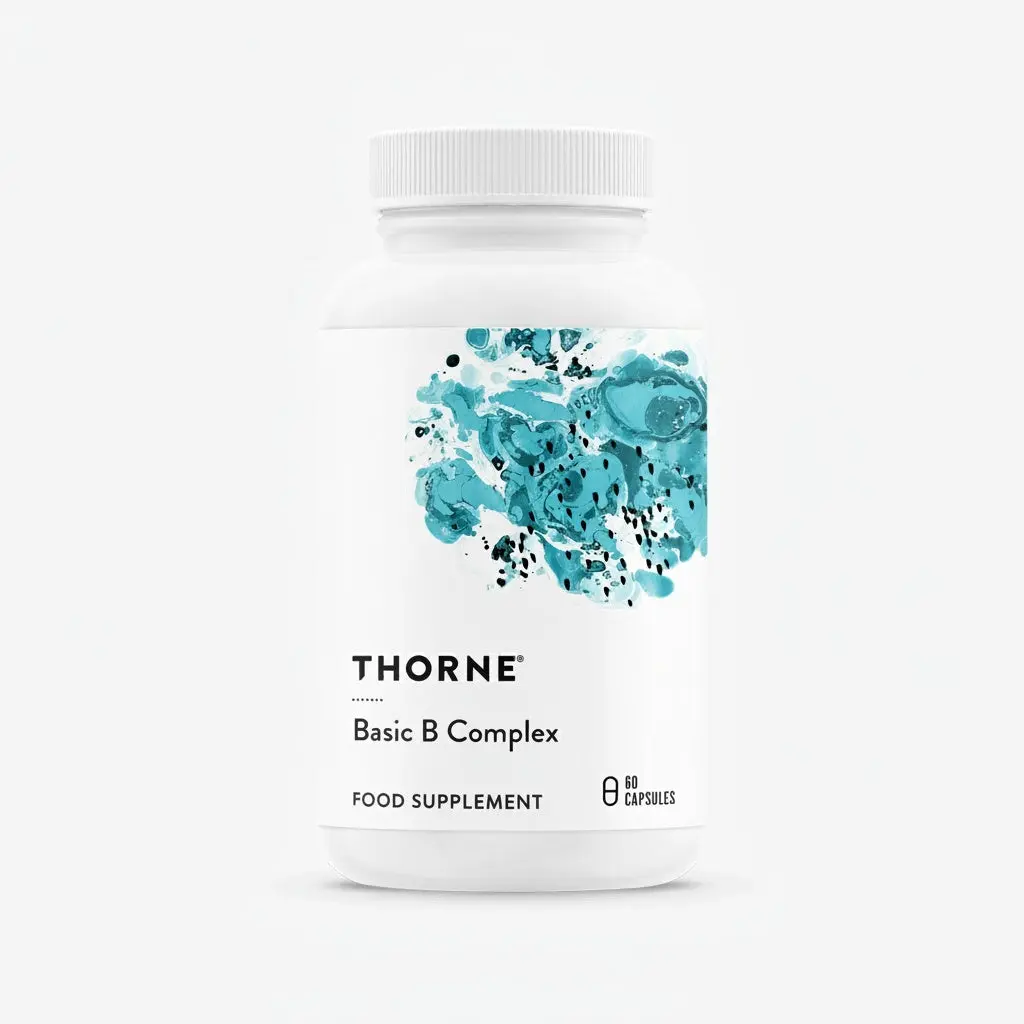
Why Thorne specifically?
Most nutritionists who've been around long enough end up recommending the same handful of brands. Thorne is one of them.
- Active forms across every B vitamin in the formula
- One capsule per dose — not three or six
- NSF-certified facility (the strictest US third-party audit)
- Used in NIH-funded clinical research trials
- Available as a subscription on Healf, so you don't run out mid-cycle
Common questions
Will I notice anything in the first week?
Some people do — slightly more vivid dreams (a normal sign B6-supported neurotransmitter synthesis is shifting), or steadier morning energy. Most people notice the difference at 2–4 weeks of consistent dosing.
Should I take it morning or evening?
Morning, with food. B vitamins are mildly stimulating; pairing them with a meal also improves absorption.
Is more better?
No. The B-vitamin dose-response curve is an inverted U — too little doesn't work, too much doesn't work harder, only the right amount of the right form moves the needle.
Does it support thyroid function?
Indirectly, yes. B vitamins are cofactors for the deiodinase enzymes that convert T4 (the inactive thyroid hormone) into T3 (the active one). People under chronic stress often have suppressed T3 conversion alongside elevated B-vitamin demand — a feedback loop adequate methylated B vitamins help break.