Up to 99% net nitrogen utilization. Most of the protein you eat: a fraction of that.
One of those numbers is settled science. One is a single inventor's clinical data nobody has replicated. We'll tell you which.
That first number is going to do a lot of work on this page, so here is the honest provenance up front: the "up to 99%" is BodyHealth's own clinical figure for their amino-acid pattern, from a single research lineage, and nobody independent has replicated it. We lead with it anyway — and we tell you it's unreplicated in the same breath — because the one thing you actually optimize for is not being fooled, and the fastest way to lose you would be to launder a brand number as settled fact.
So: one of the numbers on this page is settled science, one is a single inventor's clinical data, and we mark which is which every time.
Now the frame the rest of the page runs on. Your body has a short list of inputs it cannot synthesise from nothing and cannot store in any useful buffer overnight. Eight hours of respiration and fasting leave you mineral-flushed, dehydrated at the cellular level, and stripped of circulating amino acids — and metabolism is about to start throwing off oxidative load the moment you stand up.
You already cover these inputs. The question this page answers is not whether — you settled that years ago — but which form of each actually clears the bar your CGM, your bloodwork, and your scepticism set.
These three are one category: the fasted raw-materials stack — the rate-limiting morning inputs, in the form your body can use, without ending the fasted state you've been running since dinner.
Three inputs. Three failure modes.
You have almost certainly already run the experiment that proves the problem. You added a scoop of whey to a fasted morning and watched your CGM lift. You bought the electrolyte sachet everyone posts about and noticed it was, on inspection, three minerals and a flavour system. You took a broad-spectrum antioxidant through a training block and quietly wondered whether you were blunting the very adaptation you were training for.
None of these were stupid moves. They were the right category of move executed with the wrong form of input.
The three failure modes
- Protein / whey → most of it deaminated and excreted due to the limiting-reagent problem
- "Electrolytes" → three minerals out of the full spectrum your cells actually move
- Bulk antioxidant → too bulky and non-selective to reach the mitochondria; may scavenge signal too
Here's the part the supplement industry has a structural incentive not to make legible. When you ingest whole protein, the amino-acid ratio doesn't match what your body needs to build tissue, so protein synthesis runs only as fast as the scarcest essential amino acid allows — the limiting-reagent principle — and the surplus is deaminated: the nitrogen stripped off, converted to urea, excreted, the carbon skeleton burned or stored. Meanwhile the electrolytes category has quietly redefined hydration as a handful of minerals out of the much wider set your cells actually move. And most oral antioxidants are too bulky and too non-selective to reach where the oxidative damage happens.
The problem isn't that you're not covering the inputs. It's that the default forms of all three are lossy, imprecise, or in the wrong place.
The man who reverse-engineered the supply chain
The three failure modes above are a diagnosis. Here is where they become a protocol — and the person who reverse-engineered it matters.
Gary Brecka is a human biologist. For roughly two decades his job, for the life-insurance industry, was to read a person's biomarkers and estimate — actuarially — how long they had. What he says that work taught him is that people weren't dying of exotic disease; they were dying of small, fixable deficiencies nobody was testing for.
That's a systems claim — disease as a supply-chain problem — and it is the only frame on this page where Brecka does load-bearing work. The mechanisms below are anchored to peer-reviewed sources, not to his authority. His role is narrower and more defensible: working from the supply-chain thesis, he specified which three inputs and which form of each.
Hold the credential precisely: he is a human biologist — not an MD, not a physician, not a PhD. The science on this page stands on published research, not on his biography.
Full disclosure, because you'd find it anyway and resent the omission: Brecka co-founded H2Tab, one of the three products here. He is the protocol's author and stands behind it; he is not a neutral reviewer.
The fasted raw-materials stack
Strip the branding off and the protocol is just three rate-limiting morning inputs, each matched to one job.
Protein — the amino-acid building blocks for muscle, collagen, enzymes, neurotransmitters. Rate-limiting because synthesis stalls at the scarcest EAA, and your body can't make the essential ones.
Hydration — mineralization is the honest word. Water alone doesn't hydrate a cell; the electrolyte gradient does. The Na⁺/K⁺-ATPase that builds and maintains that gradient is one of the largest single energy expenditures at the cellular level in excitable tissue.
Antioxidant defence — selective control over the oxidative load metabolism throws off the instant you start burning fuel. The form matters more than the dose: you want to neutralise the cytotoxic radicals without flattening the signalling ones.
Three inputs. Three jobs. No overlap — and each makes the others more usable. There is no studied clinical multiplier here. The honest version is enough: three non-negotiables that are genuinely non-negotiable together, in one glass you'll actually drink, beats three good forms taken separately and inconsistently.
PerfectAmino — the protein pillar
What it is. Free-form essential amino acids — eight of them — in BodyHealth's fixed Master Amino Acid Pattern. Pre-assembled raw material your body doesn't have to digest.
How it works. Because they arrive as free amino acids rather than protein bound in long chains, there's effectively nothing to digest — absorption in roughly 23–30 minutes versus hours for whole protein. Dosed close to the body's ideal usage ratio, far less is left over to deaminate.
The independent proof point, stated precisely. In Bukhari / Wilkinson et al. 2017 (Clin Nutr 37(6):2011–2021, PMID 29031484), just 1.5 g of leucine-enriched essential amino acids — providing only ~0.6 g of leucine — stimulated muscle protein synthesis as robustly (the authors say "perhaps maximally") as 40 g of whey protein, at rest, in older women (n≈8 per group). The honest caveats: this was at rest, not post-exercise; cohort was older women, not a young trained population; the EAA-driven amino-acid rise and insulin response were lower and shorter-lived than whey's. The number is 1.5 g. It is remarkable.
Evidence grade ●●● independent · peer-reviewed
- 1.5 g leucine-enriched EAA ≈ 40 g whey for the MPS signal — Bukhari / Wilkinson 2017
- Cohort: older women, at rest — carry this caveat; do not generalise universally
- Leucine is the mTORC1 trigger; the other EAAs are the bricks
Reconciling with the 3 g leucine threshold. The "~30 g whey / 3 g leucine" threshold from bolus studies in younger subjects is the conservative ceiling for whole-protein boluses — it assumes other EAAs are rate-limiting. A complete-EAA blend reaches maximal MPS at far less leucine precisely because the other amino acids aren't scarce. Different frame; consistent biology.
The utilization figures — and whose they are.
Evidence grade ⚑ maker's data — not independently verified
- PerfectAmino "up to 99% net nitrogen utilization" — BodyHealth / Lucà-Moretti research lineage
- Whole-protein comparison figure — same source; neither number is independent consensus
- Both use a proprietary one-pass definition of "utilization" — not the standard NPU framework (under which whey and egg score near the high-nineties)
- Direction is textbook: free EAAs in an optimised ratio are incorporated more efficiently and leave less deaminated nitrogen waste than whole protein
On calories and ketosis. A few grams of free amino acids carry roughly 0.2 kcal per serving — under a calorie. No carbohydrate. No meaningful glucose response. This is not a "calories don't count because the aminos get used" argument — they carry chemical energy regardless of fate; the honest point is that the mass is tiny and the glycemic response is nil. Leucine is a mild insulin secretagogue — so the correct line is "no meaningful insulin spike", not "zero insulin."
Baja Gold — the hydration pillar
What it is. Unrefined, solar-evaporated sea salt from the Sea of Cortez — dehydrated by desert sun and wind, never heat-refined, never milled flat. Roughly 75–80% sodium chloride versus 97–99% for table salt and 95%+ for mined Himalayan. The displaced fifth of the crystal is magnesium, potassium, calcium, and a long tail of trace elements from living seawater.
How it works. Plain water with no electrolytes dilutes extracellular sodium, and the body's response is to dump the water through the kidneys. Add sodium and the water has somewhere to go. The Na⁺/K⁺-ATPase pump — 3 sodium out, 2 potassium in, every cycle, hydrolysing ATP — builds and maintains the gradient that sets cell volume and membrane potential, and it is one of the largest energy expenditures at the cellular level in excitable tissue.
The fasted-morning relevance: low overnight insulin shifts the kidneys toward natriuresis, so you've been excreting sodium while you slept. A pinch of mineral salt replaces precisely what the fasted, low-insulin state flushed.
Evidence grade ●●● textbook physiology
- Na⁺/K⁺-ATPase: 3 out / 2 in per cycle, builds and maintains gradient, major cellular energy cost
- Low insulin → natriuresis: clinical consensus; the "keto flu" mechanism
- Sodium drives cellular hydration via osmotic gradient: standard model
The honest differentiator. The mineral form and ratio: Baja Gold is harvested from living seawater, so its mineral profile reflects the seawater ratio rather than an ancient evaporite deposit. The real, smaller, true difference is which ratio of minerals you're dissolving — not a bioavailability claim on dissolution (once any salt dissolves, the ions are in solution).
Salt comparison (% NaCl / source / mineral profile)
- Table salt: ~97–99% NaCl / industrial-refined / stripped
- Himalayan: ~95%+ NaCl / ancient evaporite seabed / ancient-seabed ratio
- Baja Gold: ~75–80% NaCl / living Sea of Cortez / living-seawater ratio · larger crystal = less sodium per pinch
Honest scope on the mineral count: seawater carries dozens of elements, but most exotic trace elements are present in nutritionally negligible amounts. The functional electrolytes that do the hydration work are Na, K, Mg, Ca — those are the heroes. "Full-spectrum sea minerals" is the accurate phrase; the count is not in headline position.
On the fast: pure minerals, zero calories, zero glucose, zero insulin. Supports the fasted state by replacing what overnight natriuresis flushed.
H2Tab — the antioxidant pillar
What it is. An effervescent tablet of elemental magnesium that, dropped in water, reacts (Mg + 2H₂O → H₂↑ + Mg(OH)₂) to generate dissolved molecular hydrogen gas. The fizz is the hydrogen generating. You're watching the mechanism.
The two-layer mechanism — and why both layers matter.
Layer 1 — the famous story ●● (emerging; selectivity contested kinetically)
- Ohsawa et al., Nature Medicine, 2007: H₂ selectively reduced the hydroxyl radical (•OH) and peroxynitrite while leaving signalling ROS (O₂•⁻, H₂O₂, NO) untouched
- Origin of the "selective antioxidant / scalpel not sledgehammer" framing
- Caveat: a 2021 kinetics analysis suggests direct •OH scavenging is too slow at physiological concentrations to account for observed effects
Layer 2 — the current model ●● (emerging, peer-reviewed; not yet definitive)
- H₂ acts mainly as a signalling molecule: nudges Keap1–Nrf2 to upregulate endogenous SOD/catalase/glutathione
- Dampens NF-κB inflammatory signalling — a "thermostat," not a scrubber
- Selective support for oxidative balance without blunting training-adaptation signals
A careful reader can stand behind both layers: the selectivity finding (Ohsawa 2007) stands; the mechanism of action has been refined from brute scavenging toward signalling. The synthesis: H₂ is the smallest molecule in existence, diffuses through membranes with no transporter, reaching the mitochondria and crossing the blood-brain barrier where bulky antioxidants can't go — and once there it acts less like a bigger antioxidant and more like a thermostat. Emerging research; structure/function — not a disease claim.
The ppm number — what it actually means.
On the fast: dissolved hydrogen gas carries no caloric or glycemic load. One honest note: H2Tab uses a trace of dextrose as a reaction primer. The accurate phrasing is no meaningful sugar / trace primer — not "zero sugar." For any metabolic-fast definition (calories, glucose, insulin) it is immaterial; a strict purist who counts any dextrose at all should know it is there.
Why all three, why one glass
The reason it's one glass and not three habits isn't packaging convenience. It's that the inputs set each other up.
Hydration makes the protein work: amino acids have to be carried in solution to the tissue that uses them. A properly mineralised cell is a better delivery environment than a depleted one. Antioxidant defence protects the build: metabolism throws off oxidative stress the moment you stand up, so putting selective oxidative control in the same glass as the building blocks means raw material and the environment it's assembled in arrive together.
The behavioural argument is the one a quantified-self reader should weight most heavily. Three non-negotiables collapsed into one action is the difference between a protocol you intend to run and one you actually run every morning. The most bioavailable form of an input you skip on Thursdays underperforms a decent form you never miss.
The honest ceiling, stated plainly: no clinical multiplier here, no studied combination effect. The claim is narrower and true — each input makes the others more usable, the three gaps are real and complementary, and one glass you'll actually drink beats three good intentions you won't.
Does it break a fast? — the trust anchor
This is the claim most likely to start an argument, so we'll prove it on the axes you actually track rather than assert it.
| Input | Calories | Glucose | Insulin | Autophagy |
|---|---|---|---|---|
| Baja Gold | Zero | Zero | Zero | ✅ Neutral |
| H2Tab | Negligible | None meaningful† | None meaningful | ✅ Neutral |
| PerfectAmino | ~0.2 kcal | None meaningful | Small (leucine) | ⚠ Blunts |
†H2Tab contains a trace of dextrose as a reaction primer — immaterial for a metabolic fast; relevant only for strict fasting purists who count any dextrose.
The leucine that flips on mTORC1 to build muscle also suppresses autophagy — that's not a side effect, it's the identical mechanism that makes the protein work. The airtight version, said straight:
If you're fasting for blood sugar, insulin sensitivity, fat loss, or a clean energy fast — the stack fits cleanly.
If you're fasting specifically for deep autophagy — the amino acids will signal "build." Take PerfectAmino in your eating window. Baja Gold and H2Tab are autophagy-neutral; keep those in fasted.
The evidence ledger
Not a testimonial carousel. The proof ranked by weight:
●●● Strong — independent, peer-reviewed
- Bukhari / Wilkinson 2017: 1.5 g leucine-enriched EAA stimulated MPS comparably to 40 g whey, at rest, older women. Peer-reviewed, unaffiliated.
- Ohsawa et al., Nature Medicine, 2007: H₂ selectivity, 1,000+ follow-on papers (attributed to the molecule, read alongside the kinetics caveat and Layer 2 update).
- Na⁺/K⁺-ATPase physiology: textbook; not a marketing claim at all.
⚑ Maker's data — attribute, not independent consensus
- PerfectAmino "up to 99% NNU" — same research lineage as the whole-protein comparison figure; neither is the standard NPU framework; both attributed as design intent throughout this page.
Anecdotal — separate strip, not adjacent to the above
- Dana White's metabolic-marker reversal on Brecka's protocol — an uncontrolled n=1; attributed to both men on the record. Not evidence at this tier.
The offer
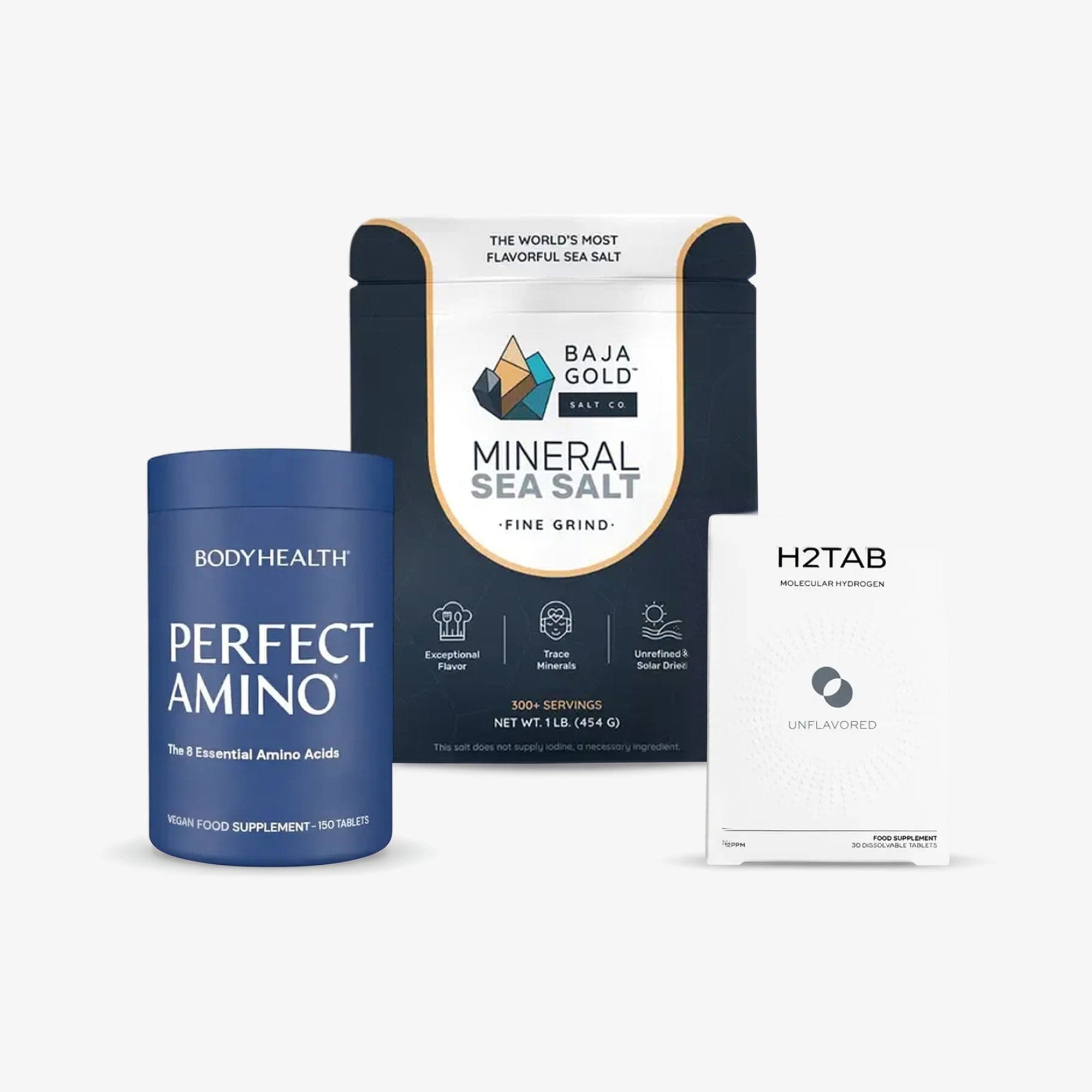
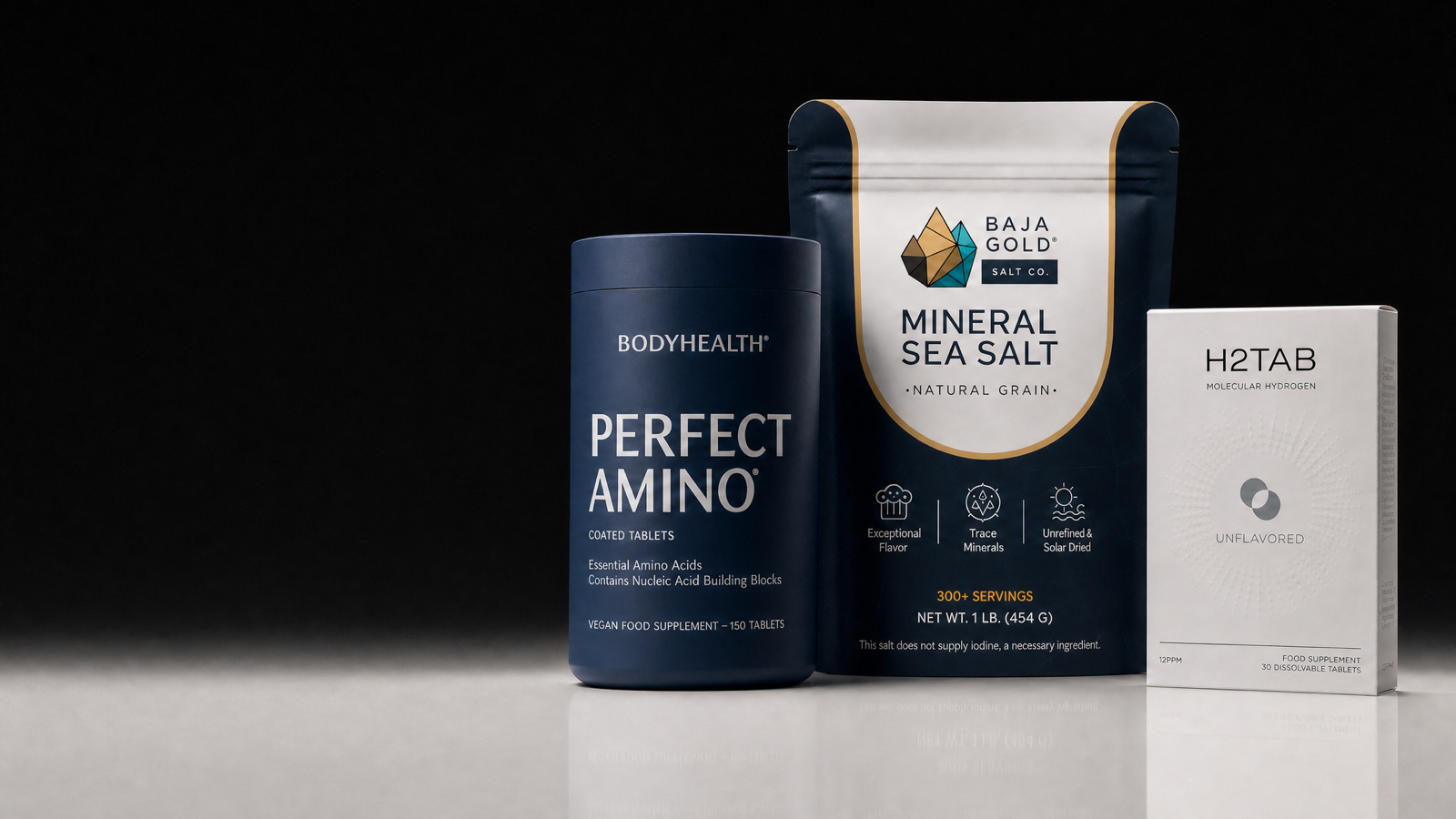
- BodyHealth PerfectAmino® — 150 tablets
- Baja Gold Sea Salt — 454g of unrefined Sea of Cortez sea salt
- H2Tab Molecular Hydrogen — 30 tablets (one a day = 30 morning glasses)
Subscribe or one-time? Run the n=1 first. Healf's 365-day return window covers the trial; subscribe later if the morning protocol holds.
Common questions — answered for a measurement-minded reader
Is the 99% utilization figure real? It's the inventor's clinical data, from a single research lineage, never independently replicated, and it uses a proprietary definition of "utilization" — not the standard NPU framework (under which whey and egg score near the high-nineties as reference proteins). Treat it as design intent, not consensus. The direction is independently established: free-form EAAs in an optimised ratio are incorporated more efficiently and waste less nitrogen than whole protein.
Won't the EAAs break my fast / kill autophagy? Not your metabolic fast — negligible calories, no meaningful glucose or insulin move. Yes, they blunt deep autophagy by the leucine→mTORC1 mechanism that makes the protein work at all. If autophagy is the goal of your fast, take them in your eating window.
Isn't the hydroxyl-scavenging story for H₂ outdated? Partly — the direct-scavenging kinetics are weak; the current model is signalling via Nrf2 / NF-κB. We lead with that, not the cartoon. The selectivity finding (Ohsawa 2007) stands; the mechanism of action has been refined.
What about the 12 ppm — is that what I actually absorb? No. 12 ppm is the peak, supersaturated concentration right after the tablet dissolves; it off-gasses from there, which is why you drink it immediately. The figure that matters is the total H₂ mass generated per tablet, not the transient peak ppm.
Is salt actually good for me? We're not telling you to over-consume sodium. Refined table salt stripped to ~99% NaCl is a different substance from unrefined sea salt at ~75–80% with its mineral matrix intact — and the specific context is the fasted morning, where you've been excreting sodium overnight. Scope matters. If you have a diagnosed blood-pressure or kidney condition, check with your doctor.
Is Brecka a doctor? No — human biologist, former mortality researcher, and co-founder of H2Tab (disclosed). His role here is the systems thesis and the protocol, not the citations. The science is anchored to peer-reviewed sources.